
Last Updated: November 2, 2026
Quick Summary
Thermal drone inspection for flat roofs uses an infrared camera to map surface temperature and reveal hidden problems such as moisture and wet insulation. Our drones use RTK positioning to tie each image to a precise roof location, and we deliver a report ranking repairs by priority.
- Wet insulation holds heat differently than dry insulation, and the camera shows that gap as a temperature difference.
- The best time for thermal roof inspection depends on solar heating, wind, and cloud cover.
- A drone covers the whole roof in one flight with no roof access and ground-level operation.
- A handheld sensor suits a quick check at a hatch or parapet but cannot cover a large commercial roof.
- Infrared inspection reads surface temperature rather than moisture directly, so it is paired with a visual walkover.
Table of Contents
- How Thermal Drone Inspection for Flat Roofs Works
- Flat Roof Moisture Detection: Reading Thermal Contrast
- The Best Time for Thermal Roof Inspection
- Thermal Roof Inspection Report: What You Receive
- Drone vs Handheld Thermal Roof Inspection
- Planning a Roof Survey: Limitations and Next Steps
- Frequently Asked Questions
How Thermal Drone Inspection for Flat Roofs Works
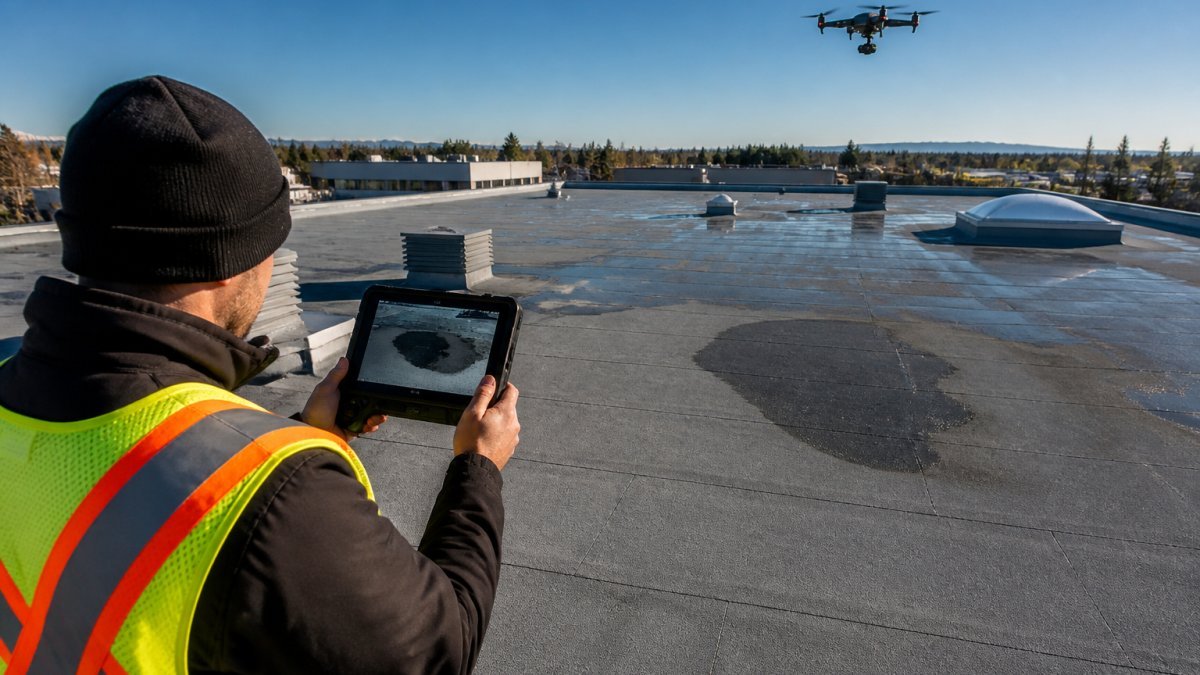
Thermal drone inspection for flat roofs uses an infrared camera to map surface temperature and reveal hidden problems. Our drones carry infrared cameras and use RTK positioning, tying each image to a precise roof location. Property inspection by drones ensures RTK accuracy.
- Plan the flight around sun, wind, and cloud cover.
- Capture visible-light and thermal frames in one pass.
- Stitch frames into a full-roof thermal map.
- Interpret contrast and flag temperature anomalies.
- Deliver a report ranking repairs by priority.
Transport Canada drone safety regulations
A flat roof hides failures well: ponding water dries, blisters look flat, and leaks travel metres before showing on the ceiling.
Flat Roof Moisture Detection: Reading Thermal Contrast
Flat roof moisture detection rests on one principle: wet insulation holds heat differently than dry insulation, and the camera shows that gap as a temperature difference. Not every dark patch is a leak, ponding water, HVAC exhaust, shade, and membrane colour can mislead, so a trained thermographer cross-checks each anomaly against visible-light imagery.
National Research Council Canada building science guidance/.do)
The Best Time for Thermal Roof Inspection
The best time for thermal roof inspection depends on conditions such as solar heating, wind, and cloud cover, which affect the thermal contrast a survey can capture. You can request a thermal drone inspection and we will confirm the best window for your roof.
Canadian Standards Association on infrared thermography
Thermal Roof Inspection Report: What You Receive
A thermal roof inspection report turns aerial data into a repair plan: the thermal map, matched visible-light and 4K imagery, close-up photographs of each anomaly, and a priority ranking so your maintenance budget goes to the right repairs first. Each flagged area gets a location, a severity note, and a recommended next step.
Drone vs Handheld Thermal Roof Inspection
Drone vs handheld thermal roof inspection comes down to access and coverage: a handheld sensor suits a quick check at a hatch or parapet but cannot cover a large commercial roof safely or consistently.
| Factor | Drone Survey | Handheld Sensor |
|---|---|---|
| Coverage | Whole roof in one flight | Small reachable areas |
| Roof access | Not required | Ladder or hatch needed |
| Worker safety | Ground-level operation | Working at height |
For an industrial or large commercial roof, the drone wins on inspection efficiency and inspection accuracy.
Infrastructure Canada asset management resources
Planning a Roof Survey: Limitations and Next Steps
Thermal data is best treated as one input alongside other methods. Infrared inspection reads surface temperature rather than moisture directly, so it is commonly paired with a visual walkover and, where needed, a core sample or moisture meter.
Frequently Asked Questions
How does a thermal drone inspection of a flat roof work?
A thermal drone inspection uses an infrared camera mounted on a drone to capture surface temperature differences across a flat roof. Wet insulation and trapped moisture heat and cool at different rates than dry sections, so they show up as distinct temperature anomalies.
When is the best time for thermal roof inspection?
The best time for thermal roof inspection depends on weather and thermal conditions, which the survey plan should account for.
Can a thermal drone detect moisture under a flat roof membrane?
Thermal imaging can show temperature differences on a roof surface that may be associated with moisture. Results depend on timing, weather conditions, and interpretation by a qualified thermographer.
A flat roof rarely fails without warning. The warning is thermal, and it shows up long before a ceiling stain. MTN Thermal Drone Services pairs ITC-certified thermographers with Transport Canada RPAS certification and RTK-positioned imagery, so you get a survey you can act on. Get started with MTN Thermal Drone Services and turn your next roof survey into a repair plan.
