
Last Updated: November 4, 2026
Quick Summary
Infrared imaging spots greenhouse crop stress by reading canopy temperature: a well-watered plant cools itself through transpiration, while a stressed plant closes its stomata and warms up. Compare canopy temperature to ambient air, look for spatial hot patches and temporal warming across repeat flights, and cross-check against soil moisture and irrigation records.
- Our team uses DJI Matrice 30T drones with FLIR infrared technology and RTK positioning.
- Infected tissue can change temperature before it changes color, which is why thermal imaging is studied for early detection.
- Commercial thermal flights require the correct Transport Canada RPAS certification for agriculture.
- Uniform canopy warming suggests water stress or heat load; first check irrigation and ventilation.
- Isolated hot spots may signal possible infection, so walk the zone and inspect leaves.
Table of Contents
- Step 1: Set Up Your Thermal Drone for Greenhouse Imaging
- Thermal Drone Applications in Agriculture: Reading Canopy Temperature
- Early Disease Detection in Greenhouse Crops and Transport Canada RPAS Certification for Agriculture
- Frequently Asked Questions
Step 1: Set Up Your Thermal Drone for Greenhouse Imaging
Infrared imaging for greenhouse crop health starts with a calibrated drone, not a flight, and infrared imaging rewards preparation. Our team uses DJI Matrice 30T drones with FLIR infrared technology and RTK positioning.
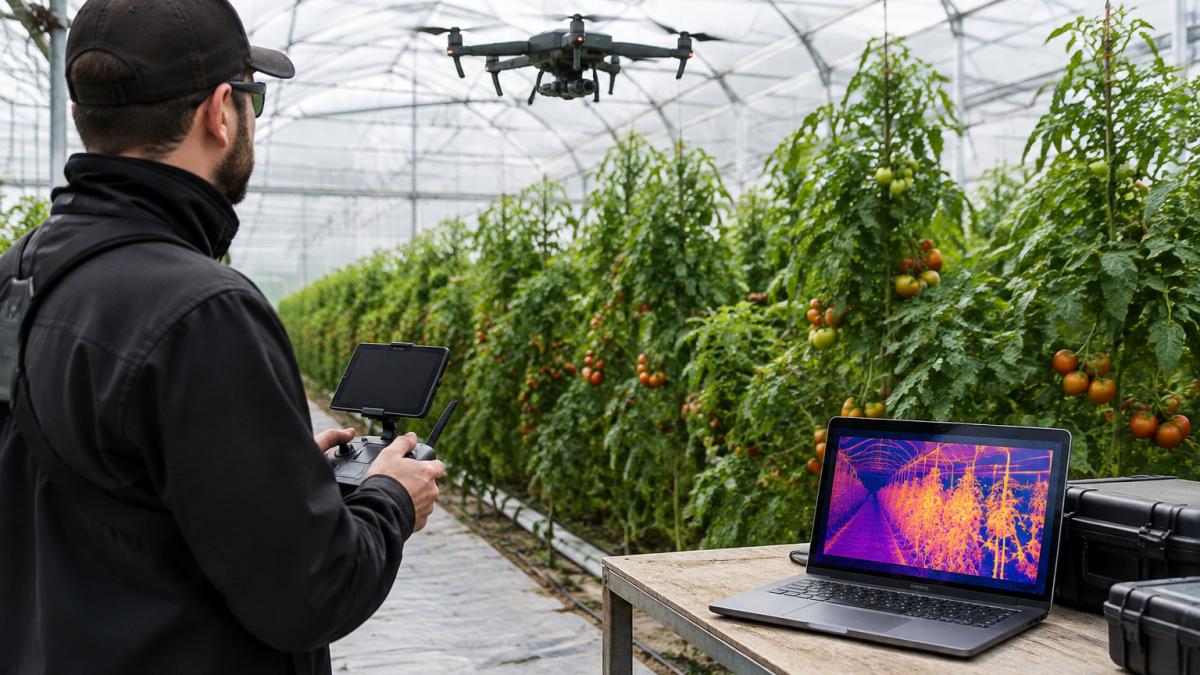
If you would rather have this done for you, you can book agricultural drone services and skip the equipment learning curve.
Thermal Drone Applications in Agriculture: Reading Canopy Temperature
Canopy temperature is a widely used signal: a well-watered plant cools itself through transpiration, while a stressed plant closes its stomata and warms up.
Compare canopy temperature to ambient air, look for spatial hot patches and temporal warming across repeat flights, and cross-check against soil moisture and irrigation records. To have a team run this for your operation, contact the thermal drone team to scope the survey.
Early Disease Detection in Greenhouse Crops and Transport Canada RPAS Certification for Agriculture
Infected tissue can change temperature before it changes color, which is why thermal imaging is studied for early detection in greenhouse crops. Commercial thermal flights require the correct Transport Canada RPAS certification for agriculture.
Confirm that your pilot and aircraft meet current Transport Canada requirements before every campaign. Our team holds advanced RPAS certification and ITC thermographer credentials. Read our drone laws guidance before you plan a flight.
| Signal | What It Suggests | First Check |
|---|---|---|
| Uniform canopy warming | Water stress or heat load | Irrigation and ventilation |
| Isolated hot spots | Possible infection | Walk the zone, inspect leaves |
| Patchy warm zones | Blocked emitters or poor airflow | Drip lines and fans |
Frequently Asked Questions
How does infrared imaging detect plant stress in greenhouses?
Stressed plants close their stomata, which reduces transpiration and raises leaf temperature. Infrared imaging captures that surface temperature difference across the crop canopy, so you can map water stress, heat stress, and early disease before visible symptoms appear. A calibrated thermal camera paired with RTK positioning lets you compare zones reliably and track changes over time.
What are the benefits of using thermal drones for greenhouse monitoring?
Thermal drones cover large greenhouse areas quickly and repeatably, giving you spatial and temporal variation data instead of spot checks.
Can infrared cameras identify irrigation issues in crops?
Yes. Poorly irrigated zones show up as warmer canopy temperature because transpiration drops.
Greenhouse thermal surveys reward preparation over gadgetry. If you want a calibrated, legally flown inspection with interpretation you can act on, MTN Thermal Drone Services brings certified thermographers, advanced Transport Canada RPAS certification, and RTK-precise FLIR imaging to your facility. Get a quote and turn canopy temperature into a decision you can trust.
